
You’ve found your dream home, now comes the step that makes it of icially yours:
property registration. For most first-time homebuyers in Kerala, this step can feel
confusing. From stamp duty to registration fees, encumbrance certificates, and
Sub-Registrar Office (SRO) visits, there’s a lot to understand before you get the keys.
Knowing the process helps you avoid costly delays and ensures legal ownership of your
new home. Whether it’s a flat in Trivandrum, a villa in Kochi, or a plot in Calicut, the
procedure for property registration in Kerala is governed by the Department of
Registration, Government of Kerala.
At Shanoor Homes, we believe informed homebuyers make confident investors. Here’s a
clear, beginner-friendly guide to help you navigate the Kerala property registration
process smoothly.
Why Property Registration Matters
Property registration isn’t just paperwork; it’s what gives you legal ownership of your
home. A registered sale deed is proof that ownership has transferred from the seller to
you.
Without registration, your ownership has no legal standing, which can cause problems
when you sell, mortgage, or inherit the property. Registration also helps:
● Establish ownership in government records
● Enable bank loans and insurance
● Verify property tax and mutation entries
In Kerala, this process is managed through the Inspector General of Registration (IGR)
and local Sub-Registrar Offices (SROs) across every district.
1. Verify Property Documents
Begin by verifying that the property has a clear title and is free from encumbrances.
Check:
● The Encumbrance Certificate (EC) — to confirm no pending loans or legal
disputes.
● The Title Deed and previous ownership documents.
● Local body approvals for construction.
● RERA registration for apartments or villas.
You can verify documents online through the official IGR Kerala portal or by visiting the
SRO.
2. Check the Fair Value of Land
The fair value of land is the minimum value set by the Kerala government for each area.
It forms the basis for calculating stamp duty and registration fees.
You can find the fair value of land or a flat by searching on the IGR Kerala website using
the survey number and the village name.
Remember: Stamp duty and registration fees are calculated on whichever is higher,
the fair value or the actual sale value.
3. Pay Stamp Duty and Registration Fees
These are mandatory charges for completing the transaction.
As per the Kerala Stamp Act, 1959, and the latest G.O.(P) No.113/2019/TD dated
24.07.2019 issued by the Department of Registration, Government of Kerala:
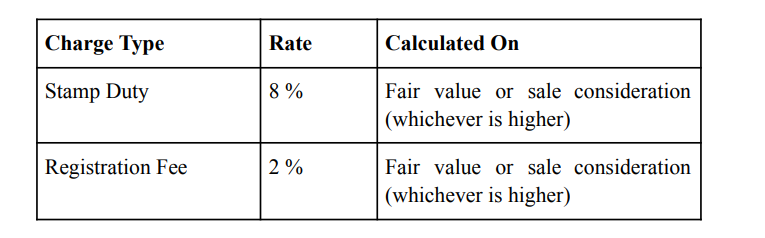
For example, if your flat costs ₹50 lakh, expect a total of about ₹5 lakh (₹4 lakh for stamp
duty and ₹1 lakh for registration fee).
You can pay the registration fee online through the IGR Kerala portal or directly at the
SRO.
4. Draft the Sale Deed
accuracy.
5. Book an Appointment Online
Registration Department website. This avoids waiting in long queues and ensures a
smooth processing experience.
6. Visit the Sub-Registrar Office (SRO)
Both buyer and seller (and two witnesses) must appear at the SRO on the appointment
date. Carry these documents:
● Original Sale Deed on stamp paper
● Proof of identity and address (PAN, Aadhaar)
● Property Tax Receipts
● Fair Value Certificate
● Two passport-size photos of the buyer and the seller
● Power of Attorney, if applicable
The Sub-Registrar verifies all details, witnesses the signing, and registers the property.
7. Collect the Registered Sale Deed
Once registration is complete, you’ll receive the digitally signed copy or physical
document of your registered sale deed. This serves as proof of ownership.
Afterwards, apply for mutation at the local village office to update the land records with
your name.
Online Property Registration in Kerala
Kerala is among the few states that have streamlined property registration through a
digital platform. On the IGR Kerala website, you can:
● Calculate stamp duty and registration fees
● Download property registration forms
● Search land records and Encumbrance Certificates (EC)
● Book appointments for SRO visits
● Check application status after submission
This digital property registration system makes the process of buying and registering
homes in Kerala more transparent and efficient.
Documents Checklist for Property Registration
Here’s a quick property registration checklist:
● Sale Deed (original)
● Title Deed / Mother Deed
● Encumbrance Certificate (EC)
● Fair Value Certificate
● Property Tax Receipts
● Buyer & Seller ID Proofs (PAN, Aadhaar)
● Two passport-size photographs
● Power of Attorney (if applicable)
Having all documents ready ensures your process moves smoothly at the SRO.
Common Mistakes to Avoid
● Not verifying the Encumbrance Certificate before purchase.
● Forgetting to update the mutation after registration.
● Ignoring digital verification of ownership documents.
● Not confirming the builder-buyer agreement terms in apartment sales.
A little diligence at this stage can prevent ownership disputes later.
Register Your Dream Home the Right Way
The property registration process in Kerala might seem detailed, but it’s designed to
protect your rights as a homeowner. Once you’ve verified your documents, paid the
correct fees, and completed registration, your ownership is fully recognised by law.
For homebuyers exploring flats, villas, or apartments in Trivandrum, Shanoor Homes
ensures full transparency, from guiding you through the buying process to helping you
understand every step of Kerala’s property registration.
Owning a home is one of life’s biggest milestones. Registering it right makes it truly
yours.
